
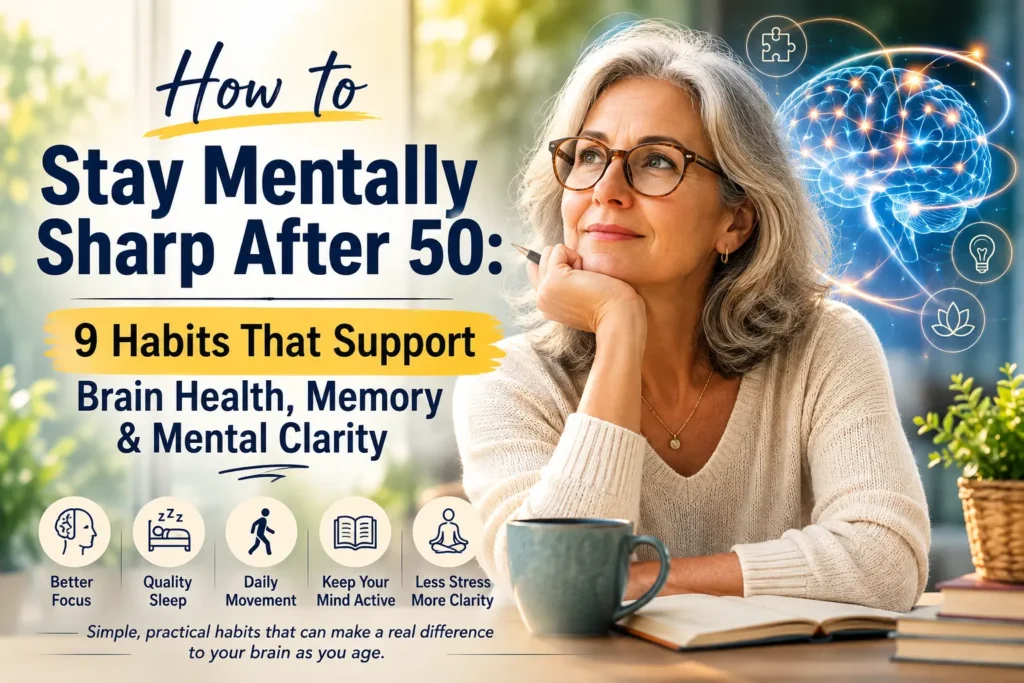
Have you noticed more forgetful moments lately? These nine everyday habits may help support brain health, memory, focus, and mental clarity as you get older.
Have you ever walked into a room and immediately forgotten why you went there?
Or had someone’s name sitting right on the tip of your tongue — you know you know it — but somehow it refuses to come out?
Maybe you have started rereading emails because you can’t remember what you just read.
Or perhaps you can concentrate perfectly well in the morning, but by afternoon your mind feels like it has simply run out of space.
If you’re over 50, these experiences can make you wonder:
“Is this just normal aging?”
“Why don’t I feel as mentally sharp as I used to?”
“Is there anything I can actually do to support my brain as I get older?”
The good news is that getting older doesn’t automatically mean losing your ability to learn, focus or stay mentally engaged.
The National Institute on Aging notes that while the brain naturally changes with age, many older adults experience only modest changes in memory and thinking, and healthy habits such as physical activity, healthy eating, learning and social engagement can support cognitive health.
That doesn’t mean there is a secret “brain hack” that can stop aging.
There isn’t.
Instead, brain health is better thought of as something influenced by many parts of your lifestyle.
And some of the most useful habits are surprisingly simple.

Why Do You Sometimes Feel Mentally Foggy After 50?
Before talking about what you can do, it’s worth understanding what you’re actually experiencing.
Sometimes what feels like a memory problem isn’t really a memory problem.
It may be mental overload.
Think about a typical day.
You wake up and check your phone.
Messages.
WhatsApp.
Email.
News.
Social media.
Work.
Family responsibilities.
Appointments.
Bills.
Shopping.
Traffic.
By lunchtime, your brain may have already processed hundreds of separate pieces of information.
Then you wonder why you can’t remember where you put your keys.
It’s not difficult to understand why many adults describe feeling mentally tired, distracted or foggy.
Sleep also matters.
The CDC notes that insufficient or poor-quality sleep can affect attention and learning, while getting enough quality sleep is important for brain health.
And physical activity matters too.
The CDC and National Institute on Aging both identify regular physical activity as an important part of healthy aging, with benefits that include sleep, mood and aspects of cognitive function.
So instead of asking:
“How do I make my brain younger?”
A better question may be:
“What can I do every day to give my brain a healthier environment?”
Here are nine places to start.

If you’ve also been noticing that mental tiredness seems to follow you through the day, you may want to read Why So Many People Feel Mentally Tired All the Time After 40.
1. Make Quality Sleep a Priority
If you want to stay mentally sharp after 50, don’t underestimate sleep.
It’s easy to think of sleep simply as the time when your body stops working.
Your brain doesn’t work that way.
Sleep is an important part of recovery, and poor sleep can affect attention, learning, mood and how clearly you think during the day.
You may notice the difference yourself.
After a good night’s sleep:
- conversations feel easier
- concentrating takes less effort
- you feel more patient
- your thoughts seem clearer
- small problems don’t feel quite as overwhelming
After a poor night?
Everything can feel harder.
And sometimes the issue isn’t simply how many hours you’re in bed.
You may spend eight hours in bed but wake repeatedly throughout the night.
You may snore heavily.
You may wake feeling unrefreshed.
You may fall asleep quickly but wake at 3 a.m. with your mind racing.
A simple place to start
Try keeping your wake-up time relatively consistent.
Reduce stimulating screen use before bed.
Keep your bedroom comfortable and dark.
And if you consistently wake exhausted despite getting enough time in bed, don’t simply assume you need more coffee. Consider discussing persistent sleep problems with a healthcare professional.
If morning fatigue is something you’ve been experiencing, you may also want to read our guide:
Why Do I Still Feel Tired After Waking Up? 7 Common Reasons After 40
2. Keep Your Body Moving
You don’t have to become a fitness fanatic to support brain health.
Walking counts.
Gardening counts.
Cycling counts.
Dancing counts.
Strength training counts.
Even household activities can contribute to a more active lifestyle.
The National Institute on Aging notes that physical activity can support mental and emotional health and may help maintain some aspects of cognitive function.
The CDC also reports that regular physical activity can benefit brain health and reduce the risk of cognitive decline and dementia.
That’s one reason a simple daily walk can be more valuable than waiting for the “perfect” workout routine.
Try this
Instead of telling yourself:
“I need to exercise for an hour.”
Start with:
“I’m going for a 15-minute walk.”
You can always do more.
The goal is consistency.
If you’re looking for a simple way to make movement part of everyday life, you may also enjoy I Didn’t Stop Loving Life… I Just Slowly Stopped Moving Without Realizing It.
3. Keep Learning Something New
One of the worst things you can do for your curiosity is convince yourself:
“I’m too old to learn that.”
You’re not.
The National Institute on Aging specifically notes that older adults can continue learning new skills and creating new memories.
And learning doesn’t have to mean going back to school.
You could:
- learn a new language
- learn to cook something unfamiliar
- pick up an instrument
- learn photography
- try a new computer skill
- read about history
- start painting
- learn a new sport
- take up gardening
- learn how to use a new piece of technology
The important part is that you’re giving yourself something unfamiliar to figure out.
Your brain shouldn’t spend every day doing exactly what it already knows how to do.

4. Stay Socially Connected
This one is easy to overlook.
We tend to think of brain health as puzzles, memory games and reading.
But conversation itself requires constant mental activity.
You listen.
You remember.
You respond.
You interpret tone.
You tell stories.
You react emotionally.
You make connections between what someone is saying now and something they told you months ago.
Social connection also matters for overall health and well-being. The CDC notes that supportive social connections are associated with better health, lower stress and healthier aging.
So don’t underestimate something as simple as:
having coffee with a friend.
Or calling your brother.
Or joining a walking group.
Or spending an afternoon with your grandchildren.
Your brain doesn’t only need information.
It needs interaction.
5. Don’t Ignore Chronic Stress
Sometimes your brain isn’t tired because you’ve done too much thinking.
It’s tired because you’ve been worrying.
There’s a difference.
You can spend an entire evening sitting on the sofa and still feel mentally exhausted because your mind is processing:
“What if…?”
“Did I remember to…?”
“What happens if…?”
“How am I going to deal with…?”
For many adults after 50, responsibilities don’t necessarily decrease.
They can actually increase.
You may be thinking about children, parents, finances, work, health, relationships and the future — sometimes all at once.
If nighttime racing thoughts are part of the problem, you may also want to read Waking Up at 3 AM With Racing Thoughts? 9 Reasons It Happens After 40
That’s why creating moments of genuine mental downtime matters.
Try:
- walking without your phone
- sitting quietly for five minutes
- journaling
- meditation
- listening to calming music
- spending time outdoors
- taking a few slow breaths before switching tasks
You don’t need to become a meditation expert.
You simply need to occasionally give your brain permission to stop processing information.
6. Eat for Overall Brain and Body Health
There is no single “best brain food.”
And you don’t need to buy an expensive superfood to support healthy aging.
The bigger picture matters.
A balanced eating pattern that includes vegetables, fruits, whole grains, protein sources and healthy fats is generally more useful than chasing one miracle ingredient.
The CDC includes balanced nutrition among the core components of healthy aging.
And remember that your brain doesn’t exist separately from the rest of your body.
Heart health, metabolic health, blood pressure, physical activity and nutrition all form part of the bigger healthy-aging picture.
So rather than asking:
“What should I eat to improve my memory?”
Try asking:
“What kind of eating pattern supports my health over the next 10 or 20 years?”
That’s a much more useful question.
7. Give Your Brain Periods of Quiet
This is one habit almost nobody talks about.
Silence.
Not music.
Not podcasts.
Not YouTube.
Not news.
Not scrolling.
Just quiet.
We live surrounded by information.
Even when you’re “resting,” you may still be consuming something.
You cook while listening to a podcast.
You walk while scrolling.
You eat while watching television.
You sit in bed while checking social media.
There’s nothing inherently wrong with these things.
But occasionally allowing yourself to sit without consuming anything can feel surprisingly refreshing.
Try taking a short walk without your phone.
Sit near a window with your morning tea.
Look outside.
Let your mind wander.
You may discover that mental rest doesn’t always require sleep.
Sometimes it requires less input.
Interestingly, this idea of deliberately reducing mental noise also made me curious about another approach: using structured listening as part of a morning routine.

Could Sound Become Part of a Morning Brain Routine?
Put on headphones.
Set aside a few minutes.
Listen.
Then continue with your day.
If you’re curious about this kind of structured listening approach, you can explore the sound-based presentation here.
8. Protect Your Hearing and Keep Engaging Your Senses
Brain health isn’t only about memory.
The National Institute on Aging describes brain health as involving cognitive, emotional, sensory and motor functions, including hearing.
Think about what happens when someone can’t hear properly in a conversation.
They have to concentrate harder.
They may ask people to repeat themselves.
Group conversations become exhausting.
Eventually, they may avoid situations they once enjoyed.
That’s why changes in hearing shouldn’t simply be dismissed as “getting older.”
If you’ve noticed that you’re turning the television louder, struggling in restaurants, or frequently asking people to repeat themselves, consider having your hearing checked.
Your senses are part of the way your brain interacts with the world.
9. Create a Deliberate Morning Mental Routine
This is where things get interesting.
Your first 30 minutes can set the tone for the rest of your morning.
Compare these two mornings.
Morning A
Wake up.
Grab phone.
Check messages.
Read bad news.
Scroll social media.
Answer emails.
Start worrying about everything you haven’t done.
Morning B
Wake up.
Drink water.
Get some natural light.
Move for a few minutes.
Sit quietly.
Read something.
Listen to something calming or stimulating.
Then begin your day.
Neither routine guarantees that you’ll have a perfect day.
But the second one creates something the first one doesn’t:
intention.
And this is where I became interested in structured listening.
Could Sound Become Part of a Morning Brain Routine?
Sound is already part of most people’s lives.
Music can change your mood.
A familiar song can bring back a memory from decades ago.
Certain sounds can help you relax.
Some people work better with background music.
Others prefer complete silence.
And there are now programs built around more structured forms of listening and auditory stimulation.
That doesn’t mean every claim made about sound and the brain is scientifically established.
It isn’t.
But the underlying idea is interesting:
Could deliberate listening become another small part of a daily mental-wellness routine?
That’s what led me to explore programs such as Brain Song and Genius Song.
The attraction isn’t that you should expect a recording to magically make you smarter.
It’s the simplicity.
Put on headphones.
Set aside a few minutes.
Listen.
Then continue with your day.
For someone who already has a morning routine, that may be an easy habit to experiment with.
If you’re curious about the sound-based approach
Explore the sound-based presentation
rather than something overly promotional like “Get Brain Song Now.”
What About Brain-Activation Programs?
While researching different approaches to mental focus, I also came across another category of programs built around the idea of brain activation.
This is where Genius Switch caught my attention.
The appeal is different from a traditional supplement.
There isn’t a bottle to remember taking every morning.
Instead, the concept is built around learning about a particular method and incorporating it into a routine.
Now, this is where I think a little skepticism is healthy.
There are plenty of products online that promise to “unlock” the brain, dramatically improve memory or make you instantly sharper.
Those claims deserve scrutiny.
No responsible wellness article should tell you that one program can prevent dementia, reverse cognitive decline or replace medical care.
But there’s a difference between making an unrealistic medical promise and simply being curious about a new approach to mental performance.
If you’re interested in the broader Genius Switch concept, the best thing to do is look at the presentation itself, understand what it actually proposes, and then decide whether it interests you.
See the Genius Switch presentation
Brain Song vs. Genius Song vs. Genius Switch: What’s the Difference?
If you’ve come across more than one of these names, it can get confusing.
The simplest way to think about them is by the angle that interests you.
| Approach | Main angle |
|---|---|
| Brain Song | Structured listening and sound |
| Genius Song | Sound/audio-based mental wellness |
| Genius Switch | Broader brain-activation / mental-performance concept |
These are different approaches, so there’s no reason to assume one is automatically better than the others. The best starting point depends on whether you’re more interested in structured listening or exploring a broader brain-focused routine.
The exact presentation, claims and offer details can change over time, so it’s worth checking the current official presentation rather than relying on an old advertisement.
And none of these should be viewed as a medical treatment.
They are better approached as wellness/educational programs that you can investigate if the concept interests you.
You Don’t Need a “Brain Hack” to Start Supporting Brain Health
This may be the most important point in the entire article.
You don’t need an expensive program to start taking better care of your brain.
You can start today.
Go for a walk.
Call someone you haven’t spoken to recently.
Read something you’ve never read before.
Get a better night’s sleep.
Put your phone away for 20 minutes.
Learn something.
Eat a balanced meal.
Take care of your hearing.
Give yourself a few minutes of quiet.
These aren’t flashy.
They don’t come with dramatic headlines.
But they’re part of the bigger picture of healthy aging.
The CDC’s healthy-aging guidance similarly emphasizes physical activity, nutrition, mental stimulation, sleep, social connection, emotional well-being and routine healthcare rather than one isolated solution.
If you’re curious about the approach, see the Genius Switch presentation and decide for yourself whether the concept interests you.
A Simple 15-Minute “Mental Sharpness” Morning Routine
If you want to experiment with a simple routine, here’s one that doesn’t require much time.
Minute 1–3: Hydrate
Have some water after waking.
Minute 3–6: Get some light and movement
Open the curtains.
Step outside if possible.
Walk around.
Stretch.
Minute 6–10: Give your brain quiet
Don’t check your phone.
Simply sit, breathe and let your mind settle.
Minute 10–15: Learn or listen
Read a few pages.
Listen to something interesting.
Or, if structured audio interests you, explore a sound-based listening routine.
The point isn’t that 15 minutes will transform your brain.
The point is that five or fifteen intentional minutes are much easier to maintain than a complicated wellness program.
And consistency matters.
When Forgetfulness Shouldn’t Simply Be Blamed on Age
There’s an important distinction here.
Occasionally forgetting someone’s name is one thing.
Frequently forgetting important information, getting lost in familiar places, struggling with normal daily tasks, or experiencing noticeable and worsening changes in thinking is something else.
Dementia is not an inevitable part of normal aging, according to the National Institute on Aging.
If you or someone close to you is experiencing persistent or worsening memory problems, speak with a qualified healthcare professional rather than relying on an online program, supplement or audio routine.
The goal of healthy-aging habits is to support overall well-being.
They aren’t substitutes for diagnosis or treatment.

The Bigger Picture: Staying Mentally Sharp Is a Lifestyle
After looking at all of this, I’ve come to think about mental sharpness differently.
It’s tempting to search for one answer.
One supplement.
One exercise.
One frequency.
One “brain hack.”
But your brain doesn’t exist in isolation.
Your sleep affects how you think.
Your stress affects how you feel.
Your physical activity affects your overall health.
Your social life affects your emotional well-being.
Your hearing affects how you interact with people.
Your curiosity determines how much you’re still learning.
And your daily environment determines how much stimulation — and how much rest — your brain receives.
So perhaps the better goal isn’t:
“How can I make my brain younger?”
It’s:
“How can I give my brain the best environment I reasonably can?”
If you’re interested in exploring some of the newer approaches mentioned in this article, you can take a closer look at the brain-focused presentation here
That is a goal you can work toward every day.
Final Thoughts
Staying mentally sharp after 50 doesn’t require perfection.
It requires attention.
Pay attention to your sleep.
Pay attention to your movement.
Pay attention to your stress.
Keep learning.
Keep talking to people.
Protect your hearing.
Give your mind some quiet.
And stay curious.
If you’re interested in experimenting with newer approaches, there’s nothing wrong with investigating them — provided you keep your expectations realistic.
For people particularly curious about sound and structured listening, the Genius Switch presentation is one place to learn more.
And if the broader idea of brain activation interests you, the Genius Switch presentation offers another approach to explore.
The important thing is not to believe every claim you see online.
But you don’t have to dismiss every new idea either.
Stay curious. Do your own research. And build the foundation first.The important thing
If you’re looking for more practical wellness ideas around healthy aging, sleep, energy and mental well-being, explore more articles from VibeWell Guide.
Frequently Asked Questions
How can I stay mentally sharp after 50?
Start with the basics: prioritize quality sleep, stay physically active, eat a balanced diet, maintain social connections, keep learning, manage stress and give your brain periods of rest and quiet.
Is forgetfulness normal after 50?
Occasional forgetfulness can happen as people age, but significant or worsening memory problems should not automatically be dismissed as normal aging. Persistent changes that interfere with daily life should be discussed with a healthcare professional.
What is brain fog after 50?
“Brain fog” is an informal term people often use to describe difficulty concentrating, mental fatigue, forgetfulness or feeling mentally unclear. It can have many possible contributors, including poor sleep, stress, medications and other health factors.
Does exercise help brain health?
Regular physical activity is associated with several aspects of brain and overall health. The CDC and National Institute on Aging both recommend physical activity as an important part of healthy aging.
Can learning new things help as you get older?
Older adults can continue learning new skills and creating new memories. The National Institute on Aging recommends staying mentally and socially engaged as part of healthy aging.
Can sound improve memory?
Sound and music can affect mood, attention and the listening experience, but that does not establish that a particular commercial audio program can improve memory or treat cognitive conditions. Claims about specific products should be evaluated carefully.
What is Genius Switch?
Genius Switch is a commercial brain-focused wellness presentation built around a particular approach to mental activation and cognitive performance. Readers should review the current presentation to understand its specific claims and methodology.
What is Brain Song?
Brain Song is a commercial audio-focused program centered around structured listening. It can be explored as a wellness/educational approach, but it should not be treated as a medical treatment for memory loss or cognitive disorders.
Is Genius Song the same as Brain Song?
The names can appear in related marketing contexts, so it’s best to check the current presentation and offer details rather than assuming they are identical.
A Note From VibeWell Guide
This article is for general educational and wellness information only. It is not medical advice and does not diagnose, treat, cure or prevent any disease.
Individual experiences with lifestyle changes, audio programs and other wellness approaches can vary. If you have persistent, worsening or concerning changes in memory, concentration or other aspects of your health, speak with a qualified healthcare professional.