
Waking up at 3 AM with a busy mind can feel frustrating, especially after 40. Here are 9 possible reasons it happens, simple nighttime habits that may help, and when to seek medical advice.

You feel tired when you go to bed.
Your body wants rest. Your eyes are heavy. You finally fall asleep.
Then suddenly, around 3 AM, your eyes open.
At first, everything is quiet. Then your mind starts.
Bills. Family worries. Work stress. Old conversations. Tomorrow’s tasks. Something someone said last week. Something you forgot to do. Something you may never need to think about again — but now it feels urgent.
And the more you try to fall back asleep, the more awake you feel.
If this has been happening more often after 40, you are not alone. Many adults notice that sleep feels different with age. The issue is not always the number of hours in bed. Sometimes, the bigger problem is sleep quality — whether your sleep feels deep, uninterrupted, and refreshing.
The CDC explains that healthy sleep is not just about getting enough hours. Quality sleep also matters, and poor sleep quality can include repeatedly waking up during the night or feeling tired even after sleeping enough.
Source: CDC — About Sleep
So if you are waking up at 3 AM with racing thoughts, this article will help you understand what may be happening, what habits may support better sleep, and when it may be worth speaking with a healthcare provider.
Is Waking Up at 3 AM Normal?
Waking up during the night can be normal.
Most people briefly wake between sleep cycles, even if they do not remember it in the morning. But it becomes more frustrating when:
- You wake around the same time repeatedly
- Your mind becomes alert quickly
- You check the clock and feel anxious
- You struggle to fall back asleep
- You wake up tired, foggy, or emotionally drained
That pattern can make the next day harder. Poor sleep can affect focus, mood, patience, energy, and how well you handle stress.
The National Heart, Lung, and Blood Institute notes that sleep deficiency can make it harder to learn, focus, react, make decisions, solve problems, and manage emotions.
Source: NHLBI — How Sleep Affects Your Health
That is why 3 AM waking is not just a nighttime problem. It can quietly affect your whole day.
Related reading: If your biggest issue is morning fatigue, read: Why Do I Still Feel Tired After Waking Up? 7 Common Reasons After 40
Why Do Racing Thoughts Feel Worse at Night?
During the day, your mind has distractions.
Messages. Calls. Work. Family. Chores. Errands. Noise.
At night, everything gets quiet. That silence can make thoughts feel louder.
You may not be more anxious at 3 AM. You may simply have fewer distractions from the thoughts that were already sitting in the background.
This is why many people say:
“I’m exhausted, but my brain won’t switch off.”
That sentence is important because it shows the real problem. Your body may be tired, but your nervous system may still be alert.
Related reading: Too Much Mental Noise After 45? Your Brain May Need a Different Kind of Reset
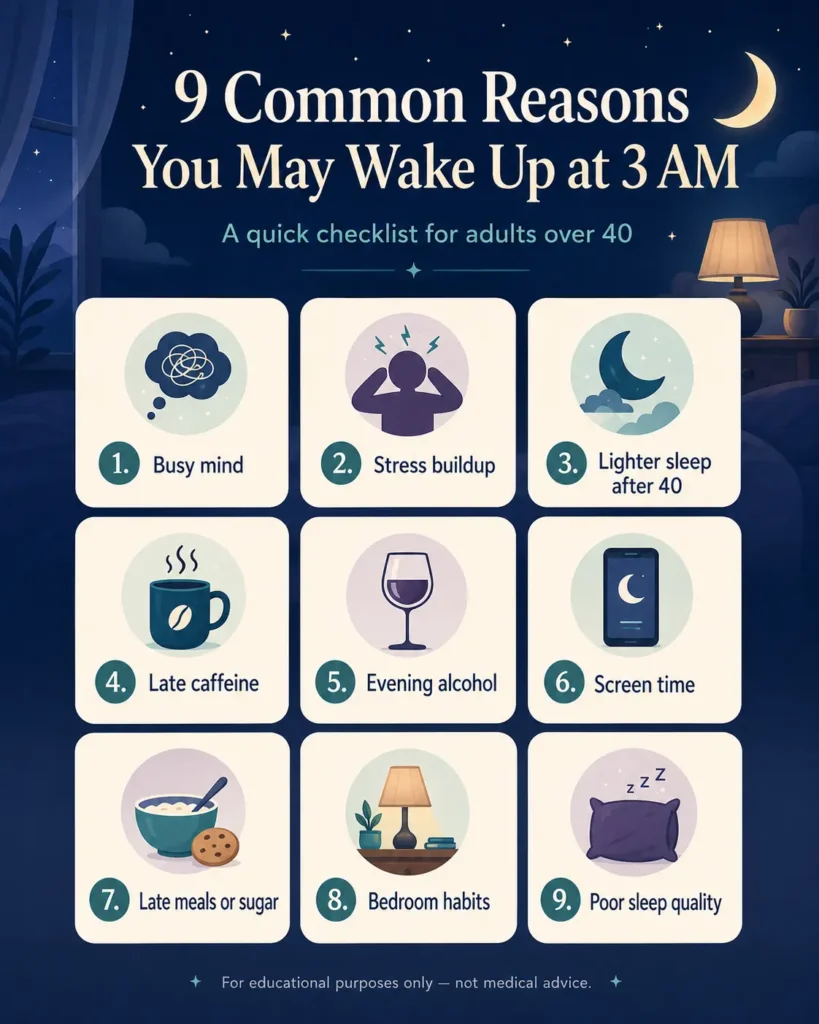
9 Reasons You May Wake Up at 3 AM With Racing Thoughts
1. Your Brain Never Got a Real Wind-Down Signal
Many people go from full-speed life straight into bed.
Scrolling. Emails. News. Family responsibilities. Late-night videos. Then suddenly, lights off.
But the brain does not always switch from “busy mode” to “sleep mode” instantly.
A simple wind-down routine tells your body that the day is ending. Without that signal, your body may fall asleep from tiredness, but your mind may stay lightly alert.
This can make it easier to wake in the middle of the night and harder to settle again.
A better wind-down signal may include dim lights, no phone, a warm caffeine-free drink, light reading, soft music, prayer, journaling, or slow breathing.
2. Stress Hormones May Still Be Active at Night
Stress does not always disappear just because you are lying in bed.
If your day was emotionally heavy, your body may still be carrying that alertness into sleep. That can make nighttime waking feel sharper.
You may wake up and immediately feel:
- “What if I forgot something?”
- “Why did that happen?”
- “What do I need to fix tomorrow?”
- “Why am I awake again?”
This is not weakness. It can be a sign that your body has not fully shifted into rest mode.
A helpful habit is to write a quick “worry list” before bed. Put tomorrow’s tasks, concerns, and reminders on paper so your mind does not feel responsible for holding everything overnight.
3. Sleep Can Become Lighter With Age
Sleep can change as we get older.
The National Institute on Aging notes that sleep tends to become shorter and lighter with age, and older adults may wake more often during the night.
Source: National Institute on Aging — Sleep and Older Adults
This does not mean poor sleep is something you must simply accept. It means your evening routine may need more support than it did years ago.
After 40, many people notice they cannot get away with the same habits they had in their 20s or 30s.
Late coffee, heavy dinners, stress, alcohol, irregular bedtimes, and screen time may affect sleep more strongly than before.
4. Late Caffeine May Be Staying in Your System
Coffee in the afternoon may feel harmless.
But for some people, caffeine can affect sleep hours later. Even if it does not stop you from falling asleep, it may affect how settled your sleep feels.
You may fall asleep normally, then wake later with your mind alert.
The CDC recommends avoiding caffeine in the afternoon or evening as part of better sleep habits.
Source: CDC — About Sleep
If you wake around 3 AM often, try a simple test:
For 7 days, avoid caffeine after lunch.
Watch whether your night waking, racing thoughts, or morning tiredness changes.
5. Alcohol May Help You Fall Asleep but Disturb Sleep Quality
Some people use alcohol to relax at night.
It may make you sleepy at first. But later in the night, it can disturb sleep quality and make you more likely to wake up.
That is why a person may fall asleep quickly after a drink but still wake around 2–4 AM feeling restless, warm, thirsty, or mentally alert.
The CDC includes avoiding alcohol before bedtime as part of healthy sleep habits.
Source: CDC — About Sleep
If you wake at 3 AM often, alcohol timing is worth noticing.
If your biggest issue is not falling asleep, but waking around 3 AM with a busy mind, there is a short video presentation explaining a simple cherry-inspired evening routine adults over 40 are talking about.
6. Screens May Delay Your Natural Night Rhythm
Phones are one of the biggest nighttime traps.
You check one message. Then one video. Then one headline. Then suddenly, your mind is active again.
Even if the content is not stressful, the habit trains your brain to stay engaged late at night.
The CDC recommends turning off electronic devices at least 30 minutes before bedtime.
Source: CDC — About Sleep
For many people, 30 minutes is a good start. But if your mind is very active at night, try 60 minutes.
Replace scrolling with something slower:
- A physical book
- A warm shower
- Calm music
- Stretching
- Prayer
- A paper journal
- Breathing exercises
The goal is not entertainment. The goal is to lower stimulation.
Related reading: The Evening Habits That Quietly Age Us Faster Than We Realize
7. Blood Sugar Swings May Be Disrupting Your Night
Some people wake at night because their body is uncomfortable.
A very heavy dinner, sugary snack, late dessert, or alcohol can affect how the body feels overnight. For some people, this may contribute to restlessness, sweating, thirst, or waking.
This does not mean every 3 AM wake-up is a blood sugar issue. But your evening food pattern is worth observing.
A simple experiment:
- Avoid heavy meals close to bedtime
- Reduce late sugar
- Avoid alcohol near bedtime
- Choose a lighter dinner
- Notice if 3 AM waking improves
The CDC recommends avoiding large meals before bedtime as part of healthy sleep habits.
Source: CDC — About Sleep
Related reading: If you are interested in energy and blood sugar patterns, read: 7 Silent Signs Your Body May Be Struggling With Blood Sugar Balance
8. Your Bedroom May Be Training Your Brain to Stay Alert
Your bedroom should feel like a place for rest.
But many people use the bed for scrolling, watching videos, worrying, working, eating, and checking notifications.
Over time, the brain may stop seeing the bed as a sleep-only place.
That can make it easier to wake at night and harder to return to sleep.
Small changes can help:
- Keep the room cool
- Keep the room dark
- Keep the phone away from the bed
- Avoid watching stressful content in bed
- Use the bed mostly for sleep
- Keep a notepad nearby instead of using your phone
The CDC recommends keeping the bedroom quiet, relaxing, and cool.
Source: CDC — About Sleep
9. You May Be Missing Deeper, More Restorative Sleep
This is the part many people ignore.
They only ask, “How many hours did I sleep?”
But the better question may be:
“How refreshed did I feel when I woke up?”
If you are waking several times, tossing, checking the clock, or feeling mentally busy at night, your sleep may not feel restorative even if you spent enough hours in bed.
That is why sleep quality matters so much.
According to the CDC, signs of poor sleep quality include trouble falling asleep, repeatedly waking during the night, and feeling sleepy or tired even after enough sleep.
Source: CDC — About Sleep
This is also where many adults begin exploring a more intentional nighttime routine.
If your biggest issue is waking around 3 AM with a busy mind, there is a short video presentation that explains a simple cherry-inspired evening routine adults over 40 are talking about.
What Can Help When Your Mind Won’t Switch Off at Night?
Before thinking about supplements, try to fix the basics first.
A strong nighttime routine does not need to be complicated. It just needs to be repeated often enough that your body recognizes the pattern.
Try this simple 7-night reset
1. Set a consistent sleep and wake time
Try not to shift your bedtime and wake time too much, even on weekends.
2. Stop caffeine after lunch
This is especially important if you are sensitive to caffeine.
3. Turn off screens 30–60 minutes before bed
Keep the phone away from your pillow.
4. Keep the room cool, dark, and quiet
A calm room helps your body feel safe enough to settle.
5. Write down your worries before bed
Do not let your brain carry tomorrow’s tasks all night.
6. Avoid heavy late meals and alcohol
Both can affect how settled your sleep feels.
7. Use the same calming cue every night
This could be reading, prayer, breathing, soft music, or a warm caffeine-free drink.
This routine gives your body a repeated message:
“The day is done. It is safe to rest.”
Related reading: Why So Many People Wake Up Tired Even After Sleeping
What About Natural Sleep Support Formulas?
Some people also explore natural sleep-support formulas when their main issue is a busy mind, broken sleep, or waking up unrefreshed.
One formula I recently reviewed is Yu Sleep.
Yu Sleep is positioned as a natural sleep-support supplement, not a sleeping pill. Its formula includes ingredients often discussed in nighttime routines, such as tart cherry, magnesium glycinate, lemon balm, L-theanine, GABA, 5-HTP, apigenin, B vitamins, and low-dose melatonin.
Important: Yu Sleep is a dietary supplement. It is not meant to diagnose, treat, cure, or prevent insomnia or any disease.
Still, if your main issue is waking around 3 AM with racing thoughts, the Yu Sleep text presentation explains the cherry-inspired evening routine in a simple, easy-to-follow way.
Prefer to read my full breakdown first? I also covered Yu Sleep’s ingredients, complaints, pricing, guarantee, pros and cons in my full Yu Sleep review.
A Careful Note About Melatonin
Many people reach for melatonin when sleep becomes frustrating.
Melatonin can be helpful for some sleep-timing issues, but it should not be treated like a guaranteed solution for every sleep problem.
The National Center for Complementary and Integrative Health says there is not enough strong evidence on melatonin’s effectiveness or safety for chronic insomnia to recommend its use. It also notes that short-term use appears safe for most people, but long-term safety information is limited.
Source: NCCIH — Melatonin: What You Need To Know
This is why it is smart to be careful with any sleep supplement, especially if you take medication, have a medical condition, are pregnant or breastfeeding, or have ongoing sleep problems.
When Should You Talk to a Doctor?
Waking up at 3 AM occasionally is not always a serious concern.
But you should consider speaking with a healthcare provider if you:
- Wake many times every night
- Feel extremely sleepy during the day
- Snore loudly
- Wake up gasping or choking
- Have morning headaches
- Have restless legs at night
- Feel anxious or low for long periods
- Take medications that may affect sleep
- Have sleep problems lasting weeks or months
- Feel unsafe driving because of tiredness
The CDC recommends talking to a healthcare provider if you regularly have problems sleeping or notice signs of a sleep disorder.
Source: CDC — About Sleep
Sleep apnea, restless legs syndrome, medication side effects, pain, hormonal changes, anxiety, and other health issues can all affect sleep. It is better to check than to guess.
Final Thoughts: 3 AM Wake-Ups Are a Signal, Not a Personal Failure
If you keep waking up around 3 AM with racing thoughts, do not blame yourself.
It does not mean you are lazy. It does not mean you are weak. And it does not mean you are simply “getting older.”
It may be your body asking for a better wind-down routine, fewer nighttime triggers, more consistent habits, or professional support.
Start with the basics:
Reduce caffeine later in the day. Keep your room cool and dark. Put the phone away before bed. Write down worries before sleeping. Give your body the same calming routine every night.
And if you are curious about the cherry-inspired nighttime routine people are discussing, you can read the full text presentation here:
Prefer to check the product details first? You can also read my full Yu Sleep review for ingredients, pricing, complaints, pros, cons, and guarantee details.
FAQs
Why do I wake up at 3 AM every night?
Waking up at 3 AM can happen for many reasons, including stress, light sleep, caffeine, alcohol, late meals, blood sugar changes, bedroom habits, medication, or sleep disorders. If it happens often and affects your day, it may be worth discussing with a healthcare provider.
Why does my mind race when I wake up at night?
Your mind may race because your body shifts into alert mode. Stress, worry, checking the clock, using your phone, or carrying unresolved thoughts from the day can make it harder to fall back asleep.
Is waking up at 3 AM a sign of insomnia?
Not always. Occasional waking is common. But if you wake often, struggle to fall back asleep, and feel tired during the day, it may be a sign of poor sleep quality or insomnia-like symptoms. A healthcare provider can help identify the cause.
What should I do when I wake up at 3 AM?
Avoid checking your phone or turning on bright lights. Keep your environment calm. Try slow breathing, a short calming thought, or sitting quietly in dim light until you feel sleepy again. If worries keep coming up, write them down before bed the next night.
Can melatonin help with 3 AM wake-ups?
Melatonin may help some people with sleep timing, but it is not a guaranteed fix for waking up at 3 AM. NCCIH notes that there is not enough strong evidence to recommend melatonin for chronic insomnia, and long-term safety information is limited.
Is Yu Sleep a sleep medicine?
No. Yu Sleep is a dietary supplement, not a medicine. It is not intended to diagnose, treat, cure, or prevent disease. If you have ongoing sleep problems or take medication, speak with your healthcare provider before using any supplement.
What is the best natural way to stop waking up at night?
The best starting point is a consistent sleep routine: regular bedtime, no caffeine late in the day, no phone before bed, a cool dark room, lighter evening meals, and a calming wind-down habit. If waking continues, seek medical advice.