
From binaural beats and brainwave frequencies to short daily listening routines — here’s what brainwave audio is, what researchers are studying, and how you can explore it for yourself.
Looking for Brainwave Audio Programs?
If you’re here because you want to explore brainwave sounds for focus, mental clarity, memory or a more intentional listening routine, there are several audio-based programs available online.
Here are three programs you may want to explore before reading the full guide.
⚡ Genius Switch
Explore sound, focus, mindset and whole-brain concepts.
🧠 Brain Song
Explore an audio-based approach centered around focus, attention and mental clarity.
🎧 Genius Song
Explore an audio program centered around mental sharpness and focused thinking.
Not sure which one interests you? Keep reading. The guide below explains what brainwave sounds actually are, how binaural beats work, what research has found so far, and how these different approaches compare.
What Are Brainwave Sounds?
The phrase “brainwave sounds” is often used online to describe audio designed around concepts such as brainwave frequencies, binaural beats, rhythmic stimulation, ambient sound or other forms of auditory entrainment.
The basic idea is interesting:
Could the sounds we hear influence how our brain behaves?
There is legitimate scientific interest in that question.
But there’s also a huge amount of marketing surrounding it.
You may have seen claims that particular sounds can instantly unlock hidden mental abilities, dramatically increase intelligence, activate a special brain state or produce extraordinary results in minutes.
Those claims should be treated carefully.
The more useful question is simpler:
Can certain types of sound influence attention, arousal, mood or cognitive performance?
Researchers have investigated different forms of auditory stimulation, including music, noise and binaural beats. The results are interesting, but they aren’t as simple as “listen to this frequency and your brain becomes smarter.”
For example, a systematic review and meta-analysis of binaural-beat research found a statistically significant overall effect across the included studies, but also reported conflicting findings across memory and attention tasks.
Another systematic review examining music and auditory stimulation found that evidence connecting auditory stimulation, physiological arousal and cognitive performance remains mixed or insufficient to draw firm conclusions.
So let’s break the subject down.
For a broader look at everyday factors that can affect how mentally clear and energized you feel, see our guide to mental fatigue after 40.
Your Brain Is Always Producing Electrical Activity
Your brain contains billions of neurons communicating with one another through electrical and chemical signals.
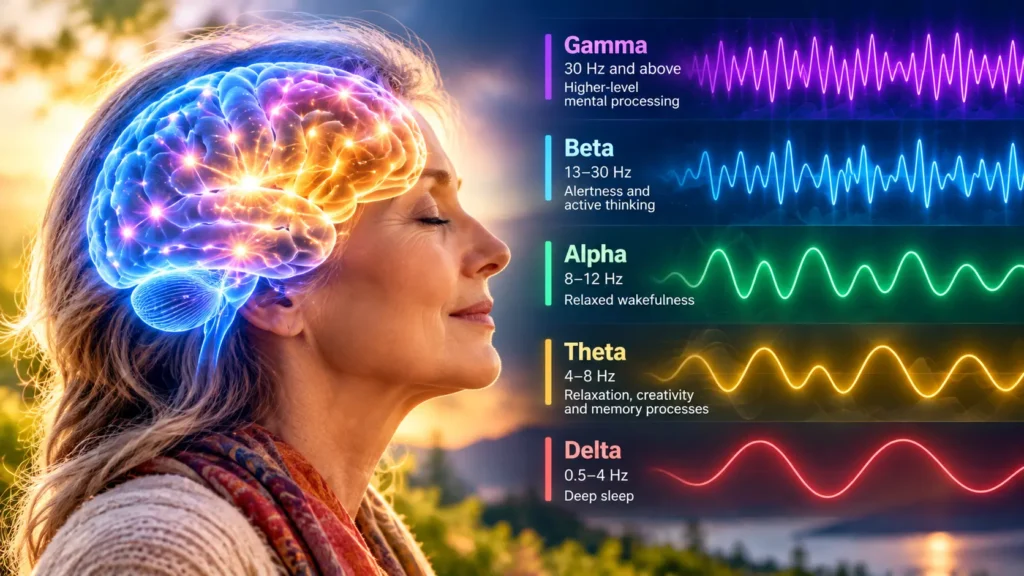
When scientists record the brain’s electrical activity using techniques such as EEG, they can observe patterns that are commonly described in terms of different frequency ranges.
These are commonly called brainwaves.
You will often see them grouped into five broad categories:
| Brainwave | Approximate range | Commonly associated with |
|---|---|---|
| Delta | ~0.5–4 Hz | Deep sleep |
| Theta | ~4–8 Hz | Drowsiness, relaxation, memory-related processes |
| Alpha | ~8–12 Hz | Relaxed wakefulness |
| Beta | ~13–30 Hz | Alertness and active thinking |
| Gamma | ~30 Hz and above | Various higher-frequency neural processes |
These ranges are useful for describing patterns of neural activity, but they shouldn’t be interpreted as five simple “modes” where your brain is only using one frequency at a time.
Real brain activity is considerably more complicated.
That’s important because some online marketing makes brainwaves sound almost like radio stations:
“Choose the right frequency and switch your brain into the desired mode.”
The science isn’t that simple.
What Is Brainwave Entrainment?
Brainwave entrainment generally refers to the idea that rhythmic sensory stimulation can influence or synchronize aspects of neural activity.
Auditory stimulation is one way researchers investigate this.
For example, a repeating sound pattern may provide rhythmic stimulation that the brain processes over time.
This is one reason you’ll encounter terms such as:
- Brainwave entrainment
- Auditory entrainment
- Brainwave audio
- Frequency audio
- Binaural beats
- Isochronic tones
- Brainwave music
- Focus frequencies
These terms are related, but they aren’t necessarily describing exactly the same thing.
What Are Binaural Beats?
Binaural beats are one of the most widely discussed forms of brainwave audio.
The basic concept is surprisingly simple.
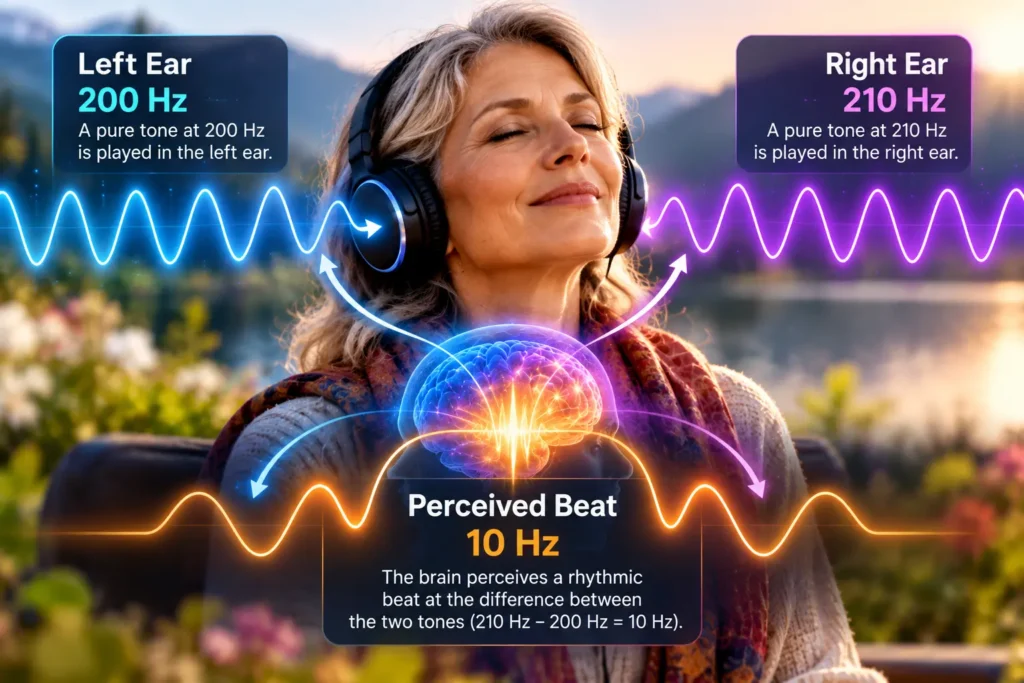
Two tones with slightly different frequencies are presented separately to each ear, typically through headphones.
For example:
- Left ear: 200 Hz
- Right ear: 210 Hz
The difference between them is 10 Hz.
The listener may perceive a rhythmic fluctuation corresponding to that difference.
This perceived beat is called a binaural beat.
Researchers have investigated whether this type of auditory stimulation can influence attention, memory, anxiety, mood and other outcomes.
But again, the evidence is not uniform.
A 2023 systematic review and meta-analysis covering 15 studies and 31 effect sizes reported an overall medium significant effect for binaural-beat interventions, while also noting conflicting results, particularly for memory and attention outcomes.
That makes binaural beats an interesting area of research — but not a scientifically established shortcut to dramatically changing cognitive ability.
Do Binaural Beats Require Headphones?
Generally, yes, if you’re specifically trying to experience a traditional binaural beat.
That’s because the two different tones need to be delivered separately to the left and right ears.
If both tones reach both ears equally through a normal speaker, the mechanism is different.
This is one reason headphones are commonly recommended for binaural-beat recordings.
However, not every piece of “brainwave music” online is actually a binaural beat.
Some recordings use:
- Ambient music
- Pulsed sounds
- Isochronic tones
- Nature sounds
- Layered frequencies
- Rhythmic sound
- Music combined with tones
So it’s worth checking what type of audio you’re actually listening to.
Can Sound Affect Focus?
This is where things get particularly interesting.
Anyone who has worked in a noisy office, studied in a quiet library or listened to music while working already knows that sound can influence the way an environment feels.
Music can affect:
- Mood
- Arousal
- Motivation
- Perceived energy
- Relaxation
- Environmental distraction
But whether a particular frequency reliably improves cognitive performance is a different question.
Research into auditory stimulation and cognition has produced mixed findings.
A 2024 systematic review of 31 studies examining music, ambient noise, white noise and binaural beats concluded that the relationships between auditory stimulation, physiological arousal and cognitive performance were mixed or insufficient to draw firm conclusions.
So rather than thinking:
“This frequency guarantees better focus.”
A more reasonable approach is:
“This type of audio may help create a listening environment that I personally find useful for concentration.”
That distinction matters.
Sound is only one part of the focus equation. Sleep, stress and daily habits can also influence how mentally sharp you feel. You can explore those factors in our guide to mental fatigue after 40.
What About Memory?
Memory is another area where brainwave audio is heavily marketed.
You may see programs suggesting that particular sounds or frequencies can dramatically improve memory.
Scientific research is more cautious.
The 2023 systematic review/meta-analysis mentioned earlier found an overall significant effect across its included binaural-beat studies, but the researchers also found conflicting results, especially around theta and beta stimulation and memory/attention tasks.
In other words:
There is research worth exploring, but the evidence isn’t strong enough to treat every “memory frequency” claim as established fact.
Memory itself is also influenced by many factors:
- Sleep
- Stress
- Attention
- Exercise
- Learning technique
- Repetition
- Age
- Environment
- Overall health
Audio is only one possible factor among many.
Why Do People Listen to Brainwave Audio?
People explore brainwave audio for different reasons.

Some want something to listen to while:
- Reading
- Studying
- Working
- Journaling
- Meditating
- Relaxing
- Doing repetitive tasks
- Taking a short mental break
For some people, the biggest benefit may not come from a special neurological effect at all.
It may simply be the routine.
Putting on headphones, switching off notifications and spending 10–20 minutes doing one task can create a deliberate period of reduced distraction.
That’s valuable by itself.
If your interest in brainwave audio comes from feeling mentally overloaded or distracted during the day, you may also want to read Why So Many People Feel Mentally Tired All the Time After 40.
Brainwave Sounds vs Ordinary Music
So what’s the difference?
Ordinary music is generally created for musical enjoyment, emotion, atmosphere or entertainment.
Brainwave audio is typically designed with a more specific purpose in mind.
It may incorporate:
- Repeating tones
- Frequency differences
- Pulsing rhythms
- Ambient sound
- Binaural beats
- Repetitive musical structures
The intention is often to create a particular listening experience associated with relaxation, focus or mental performance.
However, that doesn’t automatically mean brainwave audio will outperform ordinary music for every person.
Your response to sound is highly individual.
Some people concentrate better with silence.
Others prefer instrumental music.
Others like ambient sounds.
And some enjoy structured brainwave audio.
So What Is the “Best” Frequency for Focus?
This is one of the most common questions online.
You’ll frequently see specific frequencies promoted as:
- “Focus frequencies”
- “Study frequencies”
- “Memory frequencies”
- “Genius frequencies”
- “Brain activation frequencies”
The problem is that there isn’t one universally established frequency that can be called the best frequency for focus for everyone.
Human attention is complicated, and research findings depend on factors such as:
- The type of stimulation
- The frequency used
- Duration
- Task being performed
- Individual differences
- Study design
- Baseline cognitive state
So if a website tells you that one specific frequency is guaranteed to make everyone more focused, that’s a claim worth questioning.
What Does the Research Actually Say?
The most useful way to approach brainwave audio is to separate interesting research from strong conclusions.
Research has investigated binaural beats and other auditory stimulation for cognitive and psychological outcomes.
Some studies report positive findings.
Other studies produce weaker or inconsistent results.
The systematic review and meta-analysis of binaural beats found an overall medium significant effect across the included studies, but the authors also highlighted conflicting findings within the literature.
Meanwhile, the 2024 systematic review of auditory stimulation and cognition found mixed or insufficient evidence when examining relationships among auditory stimulation, physiological arousal and cognitive performance.
The practical takeaway?
Brainwave audio is an interesting area of research, but it shouldn’t be presented as a guaranteed cognitive enhancement technology.
That distinction allows you to explore it without expecting unrealistic results.

Three Brainwave Audio Programs You Can Explore
If you’re interested in trying a structured audio program rather than searching randomly for hundreds of recordings online, here are three programs you may want to investigate.
1. Brain Song
Brain Song is positioned around audio and concepts related to focus and mental clarity.
The appeal of a structured program is that you don’t have to spend hours searching for different frequencies and playlists.
Instead, you can explore the program’s presentation and decide whether the listening approach fits what you’re looking for.
What to consider
Brain Song may be worth exploring if your primary interest is:
- Focus
- Mental clarity
- A structured listening routine
- Audio-based cognitive exercises
2. Genius Song
Genius Song takes another audio-focused approach, with marketing centered around mental sharpness and focused thinking.
If your interest is primarily cognitive performance and mental alertness, you can watch the presentation and evaluate the approach for yourself.
What to consider
You may want to explore Genius Song if you’re interested in:
- Mental sharpness
- Focused thinking
- Audio routines
- Brain-oriented sound programs
3. Genius Switch
Genius Switch is presented around concepts involving sound, focus, mindset and whole-brain thinking.
Its marketing approach is somewhat broader than simply listening to a frequency for concentration.
As with any commercial program, it’s useful to distinguish the program’s promotional claims from what independent scientific research has established.
What to consider
You may be interested in Genius Switch if you’re curious about:
- Focus
- Mindset
- Sound-based routines
- Whole-brain concepts
- A structured listening experience
Brain Song vs Genius Song vs Genius Switch
Here’s a simple way to understand the positioning of the three programs.
| Feature | Brain Song | Genius Song | Genius Switch |
|---|---|---|---|
| Audio-based approach | ✓ | ✓ | ✓ |
| Focus-oriented | ✓ | ✓ | ✓ |
| Mental clarity messaging | ✓ | ✓ | ✓ |
| Mental sharpness messaging | — | ✓ | ✓ |
| Memory-related marketing | ✓ | ✓ | — |
| Mindset concepts | — | — | ✓ |
| Structured listening concept | ✓ | ✓ | ✓ |
| Free video presentation | ✓ | ✓ | ✓ |
Important: This table describes the general positioning of the programs, not independent scientific proof that any program produces a particular cognitive outcome.
Which Type of Brainwave Audio Should You Try?
Instead of asking:
“Which program is scientifically guaranteed to work?”
A better question is:
“What type of listening experience am I actually looking for?”
If your main interest is focus and mental clarity
You might start by exploring Brain Song.
If you’re particularly interested in mental sharpness
You might want to look at Genius Song.
If you’re interested in sound combined with broader mindset and whole-brain concepts
You might want to explore Genius Switch.
The presentations themselves can give you more information about how each program works and what the creators claim.
A Simple Way to Experiment With Brainwave Audio
If you decide to explore brainwave sounds, you don’t need to make it complicated.
Try creating a simple listening routine.
Step 1: Pick one activity
Choose something such as:
- Reading
- Writing
- Studying
- Planning
- Journaling
Step 2: Remove obvious distractions
Put your phone on silent.
Close unnecessary browser tabs.
Choose a comfortable environment.
Step 3: Listen for a short period
Start with a manageable period rather than assuming that longer listening is automatically better.
Step 4: Pay attention to your own experience
Ask yourself:
- Was it easier to stay on task?
- Did I feel relaxed?
- Did the sound distract me?
- Did I enjoy the experience?
- Would I use it again?
This is much more useful than expecting a dramatic transformation after one listening session.
If you experiment with audio as part of an evening routine, remember that the broader habits around your bedtime can matter too. See our guide to evening habits and healthy aging.
Don’t Confuse Marketing Claims With Scientific Evidence
This is especially important with brainwave products.
Some promotional materials use phrases such as:
- “Unlock your hidden genius”
- “Activate your genius brain”
- “Switch your brain”
- “Become luckier”
- “Nobel Prize discovery”
- “Transform your brain in minutes”
Those statements are marketing claims, not conclusions established by the scientific literature cited in this article.
That doesn’t automatically mean a product is useless.
It means the claims should be evaluated separately.
A commercial program can provide an interesting listening experience while some of its promotional claims may go beyond what independent research currently supports.
That’s why it’s useful to look at both sides:
What does the program claim?
and
What does independent research actually show?
Can Brainwave Audio Replace Sleep, Exercise or Learning?
No.
Brainwave audio shouldn’t be treated as a replacement for the fundamentals that support cognitive function.
If your goal is better mental performance, the basics remain important:
Sleep
Sleep plays a major role in learning, memory and overall cognitive functioning.
Physical activity
Regular physical activity is associated with numerous benefits for brain and general health.
Learning
Actual practice and repetition remain essential when developing knowledge or skills.
Managing distractions
Reducing interruptions can make it easier to concentrate.
Healthy routines
Nutrition, hydration, stress management and a consistent daily routine can all contribute to how you feel and perform.
Think of brainwave audio as something you can experiment with alongside these habits, rather than something that replaces them.
Brainwave audio should not be treated as a replacement for adequate sleep. If you regularly wake up tired despite getting enough hours of sleep, see our guide to why you may still feel tired after waking up.
How Long Should You Listen?
There isn’t one scientifically established listening duration that guarantees a specific cognitive result.
Commercial programs may recommend particular routines.
If you’re experimenting with brainwave audio, follow the program’s instructions and pay attention to how you personally respond.
If a particular recording causes discomfort, headache, dizziness, anxiety or other unwanted symptoms, stop listening.
And never listen at dangerously high volume levels.
Can You Listen While Working?
You can, provided the audio doesn’t interfere with your work.
For some people, background audio can become a useful part of a concentration routine.
For others, lyrics or repetitive sounds can become distracting.
Try comparing:
Silence vs ordinary music vs brainwave audio
while doing the same type of task.
You may discover that your own response matters more than what a promotional page promises.
Frequently Asked Questions
What are brainwave sounds?
Brainwave sounds is a broad term commonly used for audio designed around concepts such as brainwave frequencies, binaural beats, rhythmic stimulation and auditory entrainment. Different recordings use different techniques.
What are binaural beats?
Binaural beats are an auditory phenomenon produced when two slightly different tones are presented separately to the two ears. The perceived difference between the tones creates a rhythmic beat.
Do binaural beats require headphones?
Traditional binaural beats generally use separate tones delivered to each ear, so headphones are commonly used.
What frequency is best for focus?
There isn’t one universally established frequency that can be called the best focus frequency for everyone. Research results vary depending on the stimulation, task and individual.
Can brainwave sounds improve memory?
Some research has reported potential cognitive effects from binaural beats, but findings are mixed. A systematic review and meta-analysis found an overall significant effect across included studies while also reporting conflicting results in memory and attention research.
What is brainwave entrainment?
Brainwave entrainment generally refers to the concept that rhythmic sensory stimulation can influence aspects of neural activity. Auditory stimulation is one method researchers have investigated.
Is brainwave audio scientifically proven?
There is scientific research examining binaural beats and other forms of auditory stimulation, but the evidence is not strong or consistent enough to support every claim made by commercial brainwave programs.
Can I listen to brainwave audio while studying?
You can experiment with it if you find the audio comfortable and non-distracting. Whether it helps your particular study session is something you can evaluate for yourself.
Is brainwave music the same as binaural beats?
No. Brainwave music can refer to a broad category of audio, while binaural beats describe a specific auditory phenomenon involving two different tones presented separately to the ears.
Is more listening always better?
Not necessarily. There isn’t a universal rule that longer listening produces greater cognitive effects. Follow the instructions provided by the program and stop if you experience discomfort.
Ready to Explore One of These Programs?
If you’ve read this far, you probably already have a better idea of what you’re looking for.
You don’t have to accept every marketing claim.
You can simply explore the presentations, understand the approach behind each program and decide whether one fits your interests.
⚡ Explore Genius Switch
🧠 Explore Brain Song
🎧 Explore Genius Song
The Bottom Line
Brainwave audio is an interesting intersection of sound, attention, neuroscience, and human behavior.
Research into binaural beats and other forms of auditory stimulation continues to explore whether sound can influence attention, memory, arousal and other aspects of cognition.
Some findings are encouraging, while other research remains mixed.
That means the most sensible approach is neither:
“It definitely doesn’t work.”
nor:
“This frequency will unlock your brain.”
Instead, approach brainwave audio as something worth exploring with realistic expectations.
Choose a program that interests you.
Create a distraction-free listening routine.
Pay attention to your own experience.
And keep the bigger picture in mind: good sleep, physical activity, learning, stress management and healthy daily habits remain important foundations for cognitive wellbeing.
Brainwave audio can be one interesting part of a broader approach to mental energy and healthy aging. For more practical ideas, explore our healthy aging guides.
Sources & Further Reading
- Binaural beats, memory and attention: A 2023 systematic review and meta-analysis examining 15 studies and 31 effect sizes.
- Music, auditory stimulation and cognition: A 2024 systematic review examining 31 studies.